AI Applications in Power Plant Designs
Wenwu Tang & Shenen Chen
Structural System, Siting, Optimization
UNC Charlotte group involved: Center for Applied GIS (CAGIS), Department of Civil and Environmental Engineering and Department of Earth, Environmental and Geographical Sciences
AI for Power Plant Design
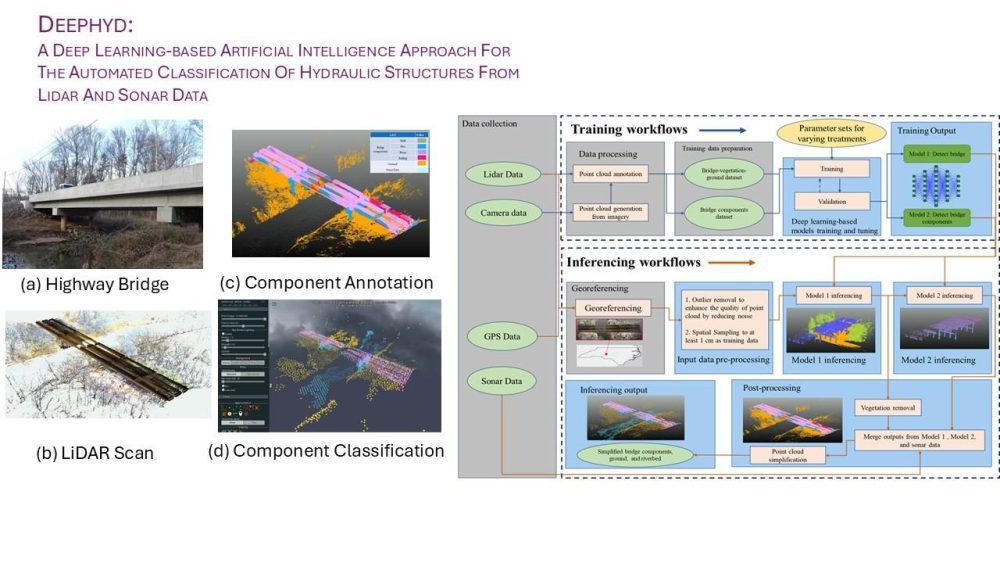
Two lectures on Artificial Intelligence (AI) were offered in Power Plant Design where students learned about the concepts of Neural Networks (NN) and students used a MATLAB code to train a 4 x 1 numeric model. To demonstrate how AI is used, a case study of training computers for automated bridge component recognition is shown in class.
What is the AI Application?
Monitoring the conditions of hydraulic structures such as bridges and culverts is essential in warranting the safety and sustainability of transportation infrastructure. Often LiDAR and sonar technologies are applied to support this monitoring need. However, the processing and classification of point cloud data generated from LiDAR and sonar techniques represents a challenge as hydraulic structures are often complicated in their geometric characteristics and considerable labor and time are needed for the processing and classification of large point cloud datasets. To address this challenge, in a NC Department of Transportation (NCDOT) project, we developed a deep learning-based 3D modeling framework and software tools for the automated classification of point cloud data of hydraulic structures. Field data from 11 sites in the Greater Charlotte Metropolitan region for the training and validation of the deep learning algorithms. The field data collection combines the use of a variety of survey instruments, including terrestrial LiDAR, sonar, total station, survey-grade GPS, and drone-based photogrammetry. The deep learning algorithm utilized for the point cloud classification is a 3D artificial intelligence technique based on convolutional neural networks. A two-tiered modeling approach was used to train deep learning algorithms using annotated point cloud data: 1) Classification of bridges from vegetation and ground, and 2) classification of specific bridge components including beam, pier, railing, and retaining walls. Web-GIS based scientific workflows (DeepHyd) to automate the processing and classification of point cloud data of hydraulic structures using deep learning were created.
Key Take Away:
Considering the diverse of highway bridge types, the automated bridge component classification tool represents a paradigm shift in transportation management. The 3D deep learning algorithms in DeepHyd achieve high classification performance on point cloud data of hydraulic structures. 3D deep learning can effectively handle the classification of large volumes of point cloud data, but the training of deep learning algorithms requires large amounts of annotated data. Students learned the critical reliance of AI on good and reliable data, but also the powerful capabilities of such tools.