Probing Chain-of-Thought Questions to Highlight Critical and Confusing Concepts
Mahmoud Dinar
Automating Lecture Generation, Machine Learning Instruction, LLMs in Engineering Education, AI-Assisted Coding & Visualization
In teaching machine learning concepts to mechanical engineering students, AI and Large Language Models (LLMs) have allowed me to improve course content, ensuring that students gain both theoretical understanding and practical application skills.
One of the most powerful ways I have used AI in teaching is to highlight subtle yet critical distinctions between similar concepts. For example, I used LLMs to probe key differentiators when explaining boosting algorithms vs. upsampling techniques. While both approaches address misclassified or underrepresented data, boosting sequentially refines weak models using weighted errors, whereas upsampling balances imbalanced datasets by generating synthetic data points. AI-generated explanations help me refine lecture content and structure discussions around these crucial differences.
Similarly, I leveraged AI to clarify the distinction between covariance in Gaussian Processes (GPs) and the actual function underlying the data. Many students assume the covariance function directly represents the true function, but it actually defines the relationships between data points rather than the function itself. By querying LLMs, I can extract explanations that illustrate how the covariance kernel controls the smoothness and generalization of predictions, helping students grasp this essential nuance.
AI has also enhanced my own thought process when analyzing complex learning algorithms. For instance, I have used AI-driven conversations to explore chains of thought when understanding new concepts. One such sequence of questions I have explored is:
- What is a particle swarm optimizer?
- How is it different from other optimization methods, like gradient descent?
- Compare it to other important optimization methods.
By prompting AI with these questions, I have discovered insights that refine my explanations and challenge students to think critically.
Another key benefit I have encountered is the ability of LLMs to generate structured lectures in HTML and LaTeX. This has made it seamless to integrate high-quality instructional content into learning management systems like Canvas. Given the mathematical rigor of engineering topics, accuracy is paramount. I have found that well-established STEM topics, such as the mathematical foundations of solid mechanics, are very unlikely to be misrepresented by LLMs. This reliability allows me to offload much of the content structuring while focusing on fostering deeper discussions in the classroom.
Another key aspect where AI has proven invaluable is visual learning. Using Visual LLMs, I have been able to generate explanatory figures that illustrate complex engineering applications. For instance, when teaching students about in-situ process monitoring with sensor data, AI-generated diagrams help them visualize the underlying mechanics of data collection and analysis. These figures have significantly enhanced comprehension, bridging the gap between abstract machine learning concepts and their real-world applications in mechanical engineering.
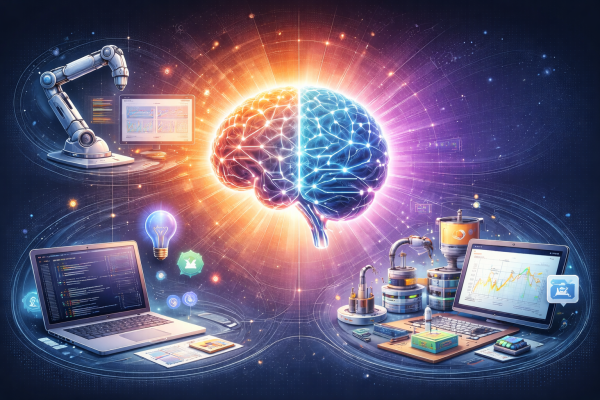
Beyond visual aids, generative AI has revolutionized brainstorming and conceptual development in the classroom. A particularly fascinating example comes from applying AI to the Split Brain Transfusion method, a design ideation technique where analytical and synthetic ideas merge. By leveraging AI to combine contrasting perspectives, we arrived at novel concepts such as sound-responsive shock absorbers—a system that adjusts damping characteristics based on environmental noise. This ability to rapidly prototype ideas through AI-generated suggestions has encouraged students to think beyond traditional engineering solutions and explore interdisciplinary innovations.
In lab-based learning, I actively encourage students to use GitHub Copilot for coding assignments and AI/ML algorithm implementations. Rather than replacing their learning efforts, this tool acts as an AI-assisted development partner, helping them debug, optimize, and structure their code more efficiently. The exposure to AI-assisted programming not only accelerates their learning curve but also prepares them for the industry, where such tools are becoming increasingly commonplace.
Overall, AI has not only enhanced my teaching but has also empowered students to learn more effectively through interactive content, visual explanations, AI-driven ideation, personalized assessments, and hands-on coding experiences. As AI continues to evolve, I am excited about the new possibilities it will bring to engineering education, pushing the boundaries of what we can achieve in higher learning environments.