My Experience with AI in Architecture
Gabrielle Ciceron & Sabri Gokmen
Architecture, Generative AI, AI-Assisted Design
During my first year in the M1 program at the University of North Carolina at Charlotte, my perspective on AI and its role in creative design completely transformed. What began as a simple experiment to test the boundaries of possibility became a defining part of my academic and personal journey, ultimately leading to my selection as a representative of the School of Architecture at the Division of Research’s Annual Research and Partnerships Celebration. I’ve also taken on a graduate research assistantship focused on how AI can be used to visualize and interpret improvisational design strategies, particularly through the lens of jazz and its influence on architectural thinking.
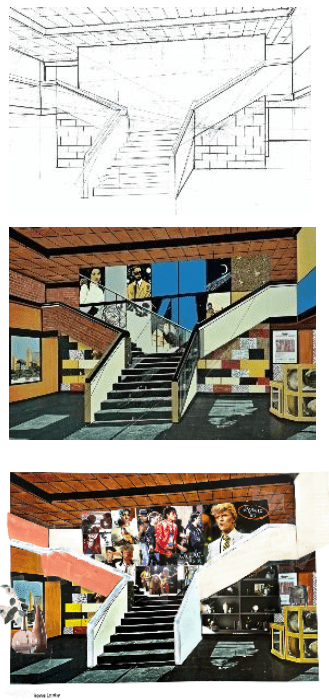
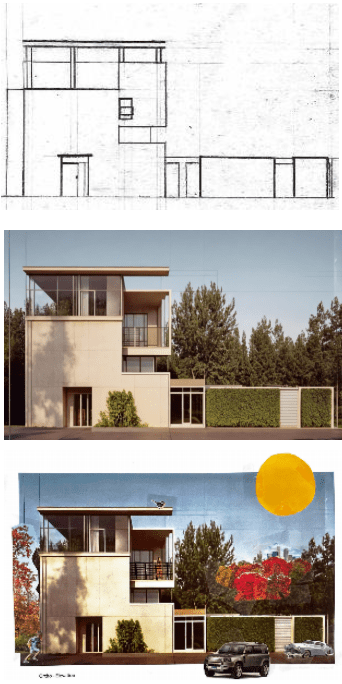
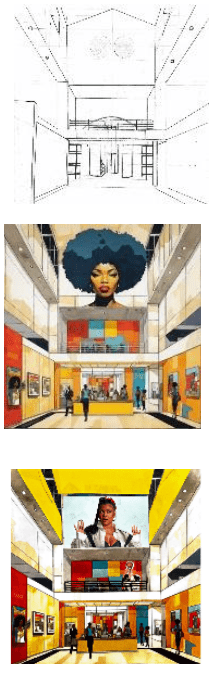
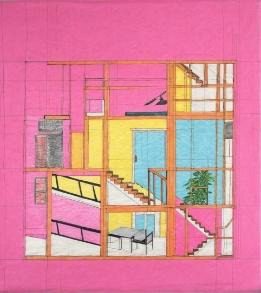
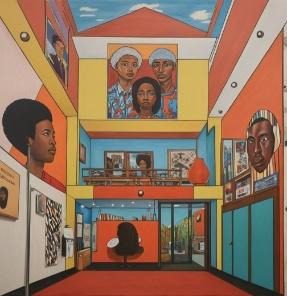
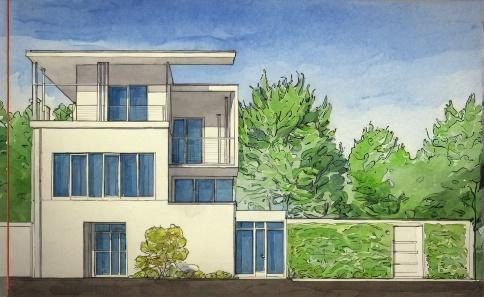
When I first encountered AI in design, I wasn’t sure what to expect. I was introduced to its potential in my Representations I class, taught by Professor Kyle Spence. Our assignment involved using PromeAI, an AI rendering platform, to create visuals from two sets of sketches. The first set included perspective drawings of various campus buildings—the Salon and Lambda Gallery in Storrs, the Rowe Arts lobby, and the Colvard breezeway. The second set came from architectural icons; I chose to reinterpret Le Corbusier’s Villa Savoye through floor plans, sections, and elevations. This assignment gave me a deep understanding of the AI-assisted design process. I broke it down into four stages: Create, Capture, Render, and Refine. The Create phase is where I generated my initial design either by hand or digitally. Next came Capture, a crucial step that determines the quality and potential of the AI output. The angle, clarity, and expressiveness of the image you choose to feed into the AI can make or break the final result. The Render stage, surprisingly, required the most attention and involvement. It’s a misconception that AI simply does the work for you. To guide the AI effectively, I had to craft detailed prompts that included style, mood, scene, and specific references. This part demanded patience—lots of it—as trial and error were unavoidable. I learned not to settle too quickly and to treat the AI as a collaborator rather than just a tool. Finally, the Refine step was where the design truly became mine again. After generating images that aligned with my vision, I would reinterpret and enhance them using other tools—or in my case, physical collage.
What made the experience even more meaningful was my decision to represent my identity in my AI-generated renderings. As a Black woman, I saw this technology not just as a tool, but as an opportunity to center my ethnicity and cultural lens in architectural storytelling. I wanted to see how far I could push my creativity while staying true to who I am, and that risk paid off in ways I couldn’t have imagined. It reinforced a key lesson that continues to guide my work: you are always in control of your creative vision. AI can support and inspire, but it’s up to you to steer the process, interpret the results, and refine them into something uniquely your own.
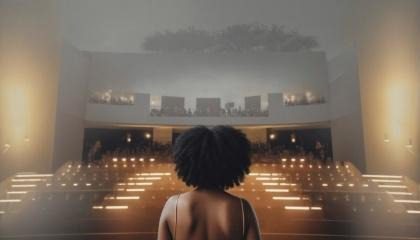
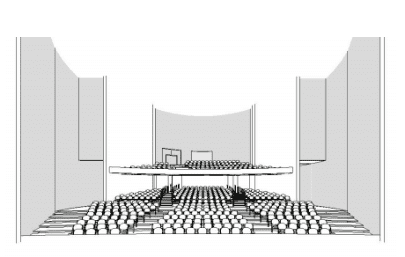
As I move forward in my studies and research, I carry that mindset with me. Whether I’m working on assignments, contributing to research, or exploring the improvisational spirit of jazz in architecture, I see AI not as a shortcut, but as a spark.