Innovative Use of Notebook LM: Transforming Course Content into Podcasts

Dr. Jules Keith-Le
Course Redesign, Podcasts, Notebook LM
I am an associate graduate faculty member in the Cato College of Education, teaching for the Learning, Design, and Technology program. I began teaching Visual Design of Instructional Products in the summer of 2024. At that time, this course was elective, fully online, and asynchronous. However, program enhancements and degree requirements changed, making the course a requirement for the graduate certificate, master’s, and doctoral programs. I needed to redesign the 5-week course to be offered during a full 16-week semester.
As an innovative instructional designer and advocate for the use of emerging technologies, I looked for generative AI tools approved and supported by UNC Charlotte to help me redesign my course. I also work for the Office of OneIT and am a leader with the UNC System Generative AI Faculty Learning Community. My involvement in promoting the use of generative AI tools by faculty and students placed me in a unique position to pilot features before they were released to the university community at large.
I was part of the Google Notebook LM pilot. One of Notebook LM’s features is the ability to input text (a PDF, website, or other word document) and have it transformed into a podcast, a conversation between two hosts. While testing Notebook LM and working on the redesign of my course, I produced the idea of Learning, Technology, Radio (LTR), which is a play on National Public Radio (NPR). While testing out the “podcast” feature that Notebook LM offers, I noticed it sounded like I was listening to a story on NPR. The university’s colors flashed in my mind and the letters “LTR.” At home, I quickly put together a logo for the fictitious radio station and began to think about how LTR could provide a supportive solution for students reading the course textbook, Connie Malamed’s Visual Design Solutions, and other course-related articles.
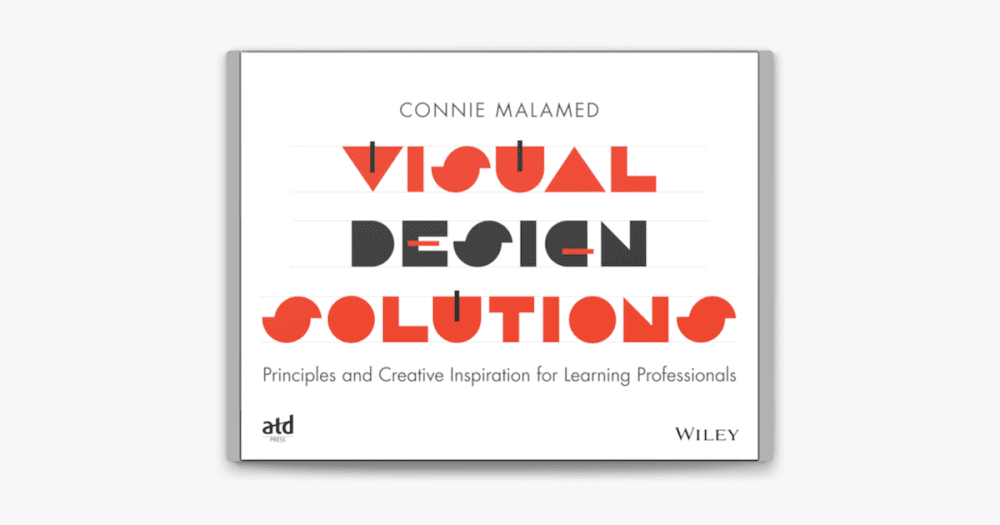
Because the course is Visual Design of Instructional Products, there are lots of important graphics in the e-book and articles that I wanted students to review. Notebook LM did a decent job of describing images, but it was important to direct students to review the reading after listening to deepen their learning. I imagined LRT as a time-saving resource in my course. Students could listen to the podcasts while driving, working out, cooking dinner, etc., then review the readings more deeply later.
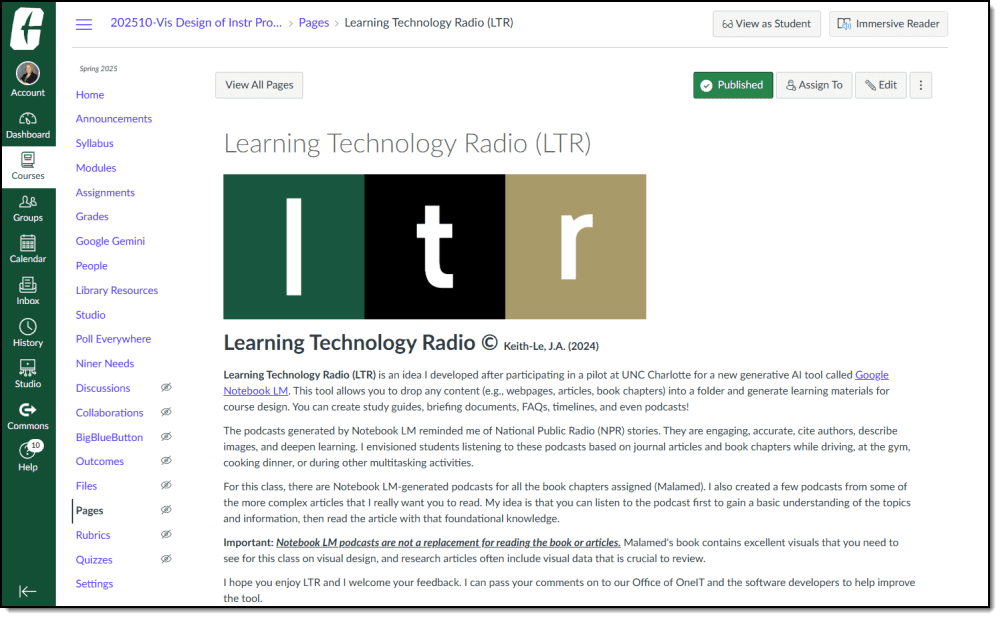
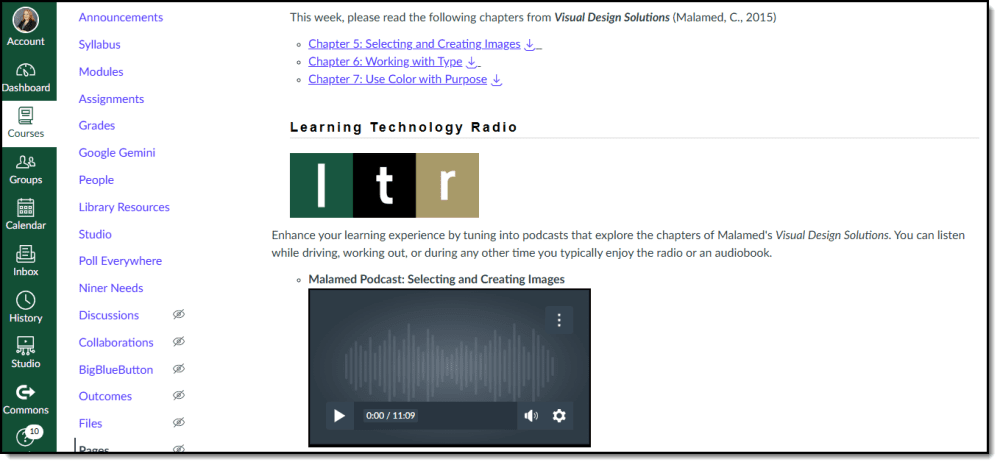
For every substantial reading assigned in Visual Design of Instructional Products, I offer an associated LTR Podcast. I review each podcast and carefully compare it to the readings before publishing it to the students. Sometimes the podcasts would go too long (over 20 minutes), and I would prompt Notebook LM to “revise and shorten” the podcast. Notebook LM did not present any “hallucinations,” and the content it created was accurate.
I am very open about my use of Generative AI in the course and even include the Google Gemini LTI in Canvas for students to use. My syllabus policy allows for the use of Generative AI with tool attribution and sharing of the prompt(s) used. I have an assignment that specifically asks students to create a new image using a generative AI tool. After this assignment, I polled my course about their experience and thoughts on the use of generative AI.
When asked about generative AI tools’ ease of use, 85% of students found the tools “very easy” and 15% found them “easy” to use. When asked about how likely they were to use generative AI tools on course assignments in the future, 43% were “very likely” and 43% were “unlikely” to use the tools, showing a major divide in how students felt about using the tools. Only 14% were neutral about future use.
As an instructor, I have found that using generative AI tools, like Notebook LM’s podcast feature, significantly enhances my course design and resources for students. These tools create more opportunities and options for students to engage with the course content in creative ways. I am highly likely to continue experimenting with incorporating generative AI tools like Notebook LM and other tools endorsed by UNC Charlotte as I continue to improve the design and flow of my course.