AI Literacy for Students
Add AI Literacy to your curriculum Today!
Faculty are encouraged to integrate Ready-to-use Canvas modules to help students use generative AI responsibly, ethically, and effectively. These modules are designed for instructors across all disciplines, these flexible resources can be incorporated into any course with minimal preparation.
Course Topics and Activities
1. AI Fundamentals
Learn how generative AI works, how to write effective prompts, and how to evaluate AI output responsibly. Activities include brainstorming, prompt chaining, image generation, and a final knowledge check.
2. AI for Brainstorming and Planning
Use Gemini to generate and evaluate ideas, identify project risks, create timelines, and organize information in a project knowledge hub.
3. AI for Research and Insights
Use Gemini Deep Research and Gemini Notebook to examine multiple sources, summarize information, create research reports, and develop an AI expert advisor.
4. AI for Writing and Communicating
Use AI to summarize meetings, develop action plans, improve drafts, adapt communications for different audiences, and practice presentations or difficult conversations.
5. AI for Content Creation
Create and refine images, videos, marketing materials, and presentations. Learners also use AI to develop design guidelines and evaluate creative work.
6. AI for Data Analysis
Use everyday language to define success metrics, clean and organize data, generate spreadsheet formulas, create visualizations, and build an interactive performance simulator.
7. AI for App Building
Learn the fundamentals of vibe coding and use Google AI Studio to create, test, troubleshoot, and refine a functional application without requiring prior coding experience.
Grow with Google: AI Professional Certificate
This course from Google and Coursera that explores AI concepts and real world applications to help students build practical skills for school, work, and the future. Students who complete the entire course can earn a Google AI Professional Certificate.

Best for
Courses that want a deeper or career-focused AI experience.

Format
Canvas module available for download from Canvas Commons.

Source
Developed by Google and Coursera.

Access the Module
To add the module to your course, click the button below to see the resource in Canvas Commons. Learn more about downloading from Canvas Commons.

Course Module Topics and Activities
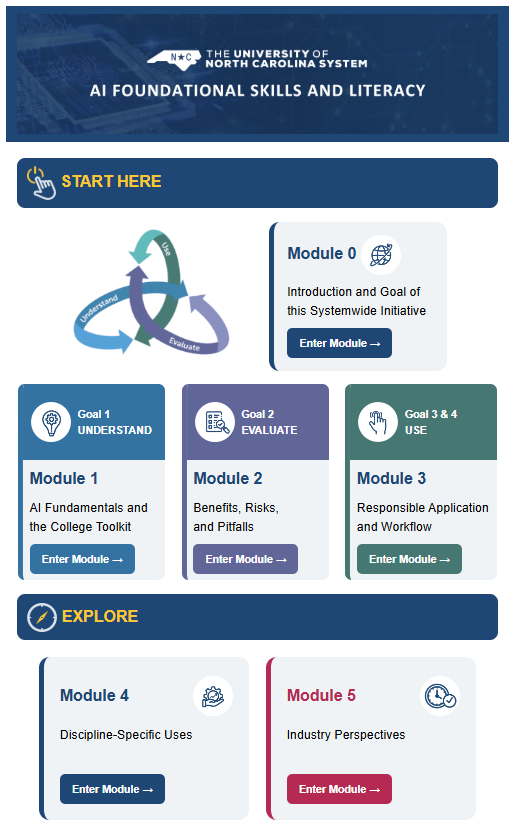
Module 0: Introduction and Goal of this Systemwide Initiative
This foundational module introduces the UNC System AI Foundational Skills Initiative. Learners explore the overarching goals, framework, and structure of the course, along with essential course mechanics including formatting, activities, assessments, disclosures regarding AI use, and information on the course development team and supported AI tools.
Module 1: AI Fundamentals and the College Toolkit (Goal 1 – Understand)
Learners cover the technical underpinnings of artificial intelligence, practical prompt engineering strategies, and methods for integrating AI into academic workflows.
- 1.1 What is AI and Generative AI? Deconstructs the core concepts, underlying technologies, and mechanisms behind modern AI and generative AI models, ending with a knowledge check.
- 1.2 Explaining How AI Tools Work: Explores predictive modeling, output topologies, and prompt engineering frameworks. Includes hands-on exercises for creating study aids, critiquing AI outputs, and performing policy audits.
- 1.3 AI in Your Academic Life: Focuses on leveraging generative AI as a personalized learning partner for research, critical thinking, productivity, and time management while establishing core guardrails.
- Module 1 Check-Out: Evaluates overall foundational AI literacy through instructor-graded assessments (offered with AI-enabled and non-AI options) and a comprehensive module quiz.
Module 2: Benefits, Challenges, and Pitfalls (Goal 2 – Evaluate)
Learners analyze both the transformative opportunities and operational risks of using generative AI across academic, professional, and personal environments.
- 2.1 The Assess-Plan-Learn Framework: Introduces a structured framework designed to help students evaluate tasks, plan strategic AI usage, and optimize their learning outcomes.
- 2.2 The Promise: Benefits of Strategic Use: Examines how deliberate AI integration enhances writing, productivity, feedback loops, professional workflows, and creative collaboration.
- 2.3 The Perils: Challenges and Pitfalls: Highlights the limitations, risks, and potential drawbacks of over-relying on AI across academic, workplace, personal, and environmental settings, paired with reflective exercises.
- Module 2 Check-Out: Synthesizes module concepts through an applied evaluation project and a final knowledge assessment quiz.
Module 3: Responsible Application and Workflow (Goals 3 & 4 – Use)
This module establishes clear ethical boundaries, policy guidelines, and practical workflows for responsible AI deployment.
- 3.1 Foundational Knowledge for Responsible Use: Covers the essential principles required to maintain ethical boundaries when working with AI tools.
- 3.1.1 Academic Integrity Principles: Defines core academic integrity standards in the context of emerging technologies.
- 3.1.2 Distinguishing Between Using AI for Assistance and Completion: Clarifies the boundary between AI-assisted learning and non-academic task completion.
- 3.1.3 Understanding Institutional Policies Regarding AI Usage: Teaches students how to locate, interpret, and adhere to specific institutional and course-level AI policies.
- 3.1.4 Core Ethical Risks: Details key societal and technical risks, including data privacy, algorithmic bias, copyright concerns, and intellectual property.
- 3.2 Applied Ethical and Responsible Practices: Focuses on real-world execution, covering proper citation methods, transparency practices, ethical decision-making frameworks, and case study analysis.
- Module 3 Check-Out: Tests mastery of AI transparency, citation standards, and institutional policies through an instructor-graded audit lab and a module quiz.
Module 4: Discipline-Specific Uses (Optional)
An exploratory module detailing how generative AI tools apply to specific academic and professional fields.
- 4.1 AI in Art & Design: Examines generative image models across media domains—still images, motion graphics, 3D spatial design, and audio—alongside mixed-modality workflows, best practices, and industry terminology.
- 4.2 AI in MathematicsAnalyzes the intersection of mathematics and artificial intelligence.
- 4.2.1 The Mathematics of AI (and AI for Math): Covers the underlying mathematical principles that power AI systems and how AI aids discovery and education.
- 4.2.2 Generative AI for Learning Mathematics: Explores AI as a math learning partner, addressing common technical pitfalls, avoiding over-reliance, and encouraging productive struggle.
- 4.3 AI in English Studies: Explores how AI transforms reading, research, and writing processes while emphasizing authorial voice, authenticity, and human critique.
- 4.4 AI in Business: Demonstrates practical business applications of AI, offering six concrete enterprise use cases and hands-on exercises.
- 4.5 AI in Health Sciences: Surveys clinical decision support, administrative operations, public health regulation, and ethical considerations surrounding health equity and human-AI collaboration.
- 4.6 AI in Library and Information Science: Examines how AI tools impact archival preservation, information organization, public library services, and collection management systems.
Module 5: Industry Perspectives (Optional)
Provides access to external, industry-aligned learning pathways, featuring specialized AWS Skill Builder courses to build market-ready technical skills.
Course Completion & Certificate
Outlines the criteria for earning the official UNC System Co-branded Certificate, granted upon successfully completing Modules 1, 2, and 3.
UNC System Foundational AI Skills for Students
This course explores foundational AI concepts and real-world applications to help students understand AI fundamentals, including how AI tools work, benefits, risks, and pitfalls, and responsible workflow and application in college life and beyond. Students who complete Modules 1-3 (at minimum) can earn a UNC System AI Foundational Skills and Literacy course Certificate of Completion.

Best for
Courses that want to provide a foundational overview of AI, including applications in higher education, industry, and daily life.

Format
Importable Canvas course .imscc file.

Source
Developed by a team of 20 faculty, librarians, and instructional designers across the UNC System with support from Amazon Web Services.

Access the Module
To add the module to your course, click the button below to submit the course request form. The course file will be emailed to you, along with a helpful how-to guide. Learn more about how to add the course file to your course.

Faculty Tip
You can import one or all modules depending on your course goals. Many instructors introduce AI Literacy at the start of the semester or before assignments where students may use AI tools.
Need more help?
The Center for Teaching and Learning is here to help you incorporate AI Literacy into your course.