Expanding the View: AI and Educator Collaborations for Student Success
Dr. Angela Du
AI Literacy, AI Collaboration in Course Design, AI Educational Partnerships, AI Use in Discussions, Human-Centric Design with AI
Dr. Angela Du, a Clinical Professor of Economics in the Belk College of Business, has recently embarked on her journey into the realm of artificial intelligence with a blend of cautious curiosity and forward-thinking resolve. Having joined UNC Charlotte in 2023, she now stands at the intersection of traditional economic instruction and emerging digital innovation—a space that promises both opportunity and challenge.
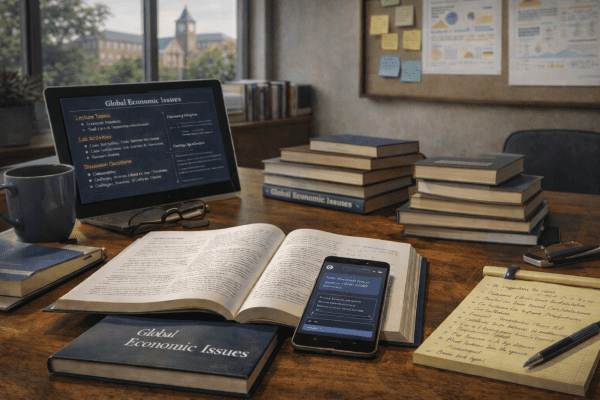
Despite describing herself as a beginner in the field of AI, Dr. Du is already laying the groundwork for what she believes will be a transformative shift in her teaching and research. Her current course on global economic issues, a subject she had not taught before, presented an unexpected hurdle: the absence of a comprehensive, high-quality textbook. Faced with a gap in available resources, Dr. Du turned to AI as a creative ally. Over the past few months, she has experimented with several AI tools, including popular platforms like ChatGPT and the newly introduced DeepSeek—a Chinese-developed AI that has been gaining traction for its innovative capabilities.
In her quest for a more dynamic curriculum, Dr. Du used AI to generate creative ideas for both her lectures and accompanying lab sessions. She recalls a moment when, in preparation for her course, she simply asked an AI tool for suggestions on structuring her global economic issues class. The response was not only practical but also sparked a series of fresh concepts that she plans to incorporate into the course for the upcoming summer term. “The ideas provided by the AI were excellent,” she reflects, noting that they helped her see new ways to engage her sophomore students more effectively. Moreover, Dr. Du is considering the use of AI to streamline administrative tasks, such as grading discussion posts on Canvas—a move that could allow her to devote more time to personalized instruction and critical analysis.
Yet, with these promising innovations come notable concerns. Dr. Du is acutely aware of the potential pitfalls that accompany the integration of AI in the classroom. One significant challenge she anticipates is the ease with which students might use AI tools to bypass genuine learning. In several instances, she observed that some students, when given discussion topics or practice questions, submitted answers that were overly polished and comprehensive—outputs that bore the unmistakable hallmarks of AI-generated content. While these answers might appear impressive at first glance, they often lacked the nuanced understanding that comes from deep, independent thought. “If students simply copy and paste answers generated by AI, they miss the opportunity to engage critically with the material,” Dr. Du warns. She believes that the instructor’s role is more crucial than ever: educators must design assignments and examinations that require individual interpretation and original thought, ensuring that technology serves as a supplement rather than a substitute for learning.
Dr. Du
Looking ahead, Dr. Du envisions a future where AI plays an increasingly dominant role in both education and research. She is committed to staying abreast of technological advancements by attending upcoming AI summits and workshops, which she believes are essential for all faculty members. “Faculty need to learn these AI tools as early as possible,” she asserts, highlighting the pressing need for educators to master digital technologies in order to prepare their students for a rapidly evolving academic and professional landscape. Dr. Du is optimistic that by integrating AI into her teaching methods, she can help bridge the gap between traditional economic theories and the modern digital economy, ultimately enriching the learning experience for her students.
In this balancing act between innovation and integrity, Dr. Angela Du stands as a forward-thinking educator—one who is eager to harness the power of AI while remaining vigilant about its limitations. Her journey, though just beginning, reflects a broader shift in academia: a willingness to embrace technological change, coupled with a commitment to ensuring that such advances enhance, rather than undermine, the fundamental principles of education.